
Preparing for Summer Screen Battles
May 25, 2026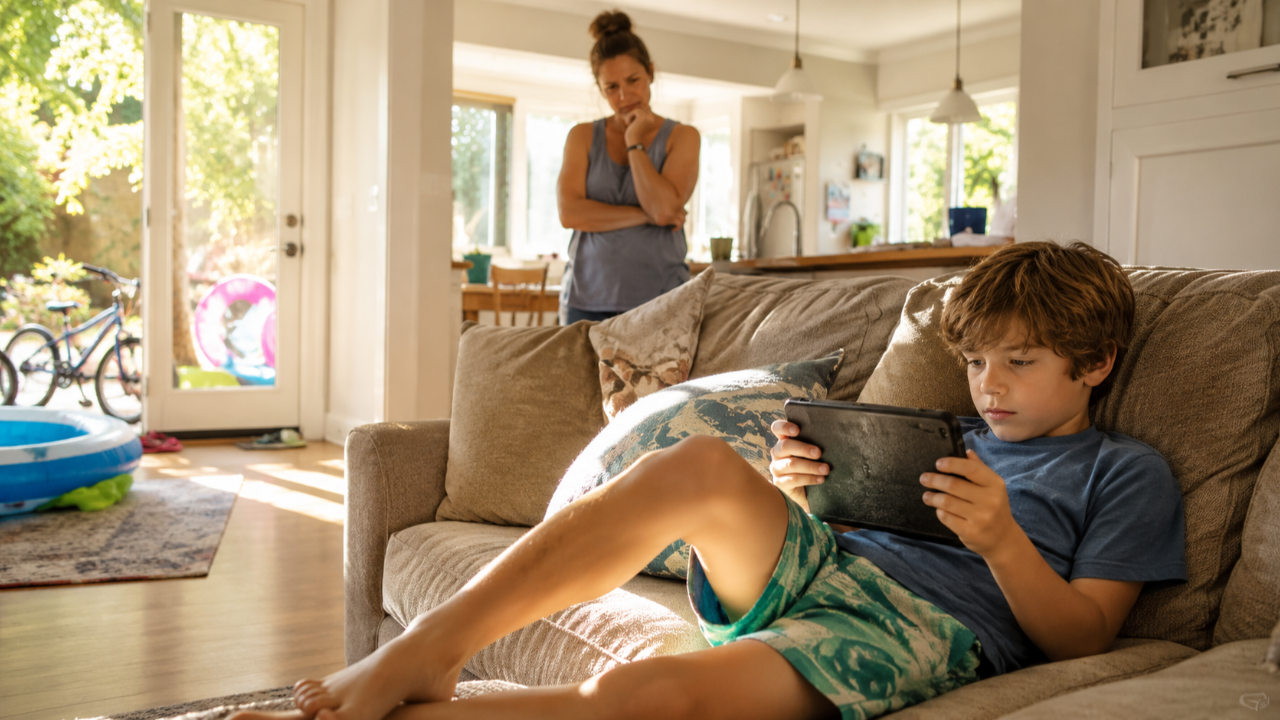
As summer approaches, many parents start feeling anxious about screens.
School routines disappear.
Bedtimes get later.
Kids have more unstructured time.
Parents are trying to work, manage the house, survive the constant requests for snacks, and somehow keep everyone entertained for months.
And before we know it, screens can easily become the default.
If you’re already dreading the constant:
“Can I have my tablet?”
“How much longer?”
“I’m bored!”
“Just one more show!”
…you’re definitely not alone.
Summer tends to magnify screen struggles because kids suddenly have much more free time, much less structure, and far fewer built-in transitions throughout the day.
The good news is that you do not need to entertain your kids 24/7 to have a successful summer.
And you also do not need to eliminate screens completely.
But it does help to go into summer with a plan.
Summer Changes the Rhythm of Family Life
During the school year, much of the day is already structured:
- school
- homework
- activities
- sports
- bedtime routines
In summer, all of that changes.
Without structure, kids naturally gravitate toward the things that provide the fastest and easiest stimulation, and screens are very good at doing exactly that.
Screens:
- instantly eliminate boredom
- provide constant stimulation
- require very little effort
- give immediate rewards
- help fill long stretches of unstructured time
And honestly, sometimes they also give parents a much-needed break.
That’s why I encourage parents to approach summer screen time with compassion instead of guilt.
Screens are not the enemy.
But without some awareness and structure, they can very easily begin taking over the rhythm of family life.
Boredom Is Not an Emergency
One of the biggest mindset shifts that helps parents during summer is understanding that boredom is not a problem that always needs to be solved immediately.
Many kids today are so used to constant stimulation that even short moments of boredom can feel uncomfortable to them.
But boredom actually serves an important purpose.
Boredom helps kids:
- develop creativity
- problem solve
- build frustration tolerance
- use imagination
- learn independence
- develop internal motivation
The challenge is that boredom often comes before creativity.
And many kids never stay in the boredom long enough to get to the creative part because screens immediately remove the discomfort.
This is why some pushback around screens during summer is completely normal.
Your child’s brain may genuinely prefer the fast stimulation of a screen over slower-paced real life activities.
That does not mean you are doing something wrong by setting boundaries.
Create Rhythm Instead of Controlling Every Minute
One mistake many parents make is feeling like they need to constantly entertain their kids all summer long.
That’s exhausting.
Instead of trying to control every moment, focus on creating some general rhythm and predictability throughout the day.
Kids tend to do better when they know what to expect.
For example:
- outside time first
- screens later in the afternoon
- no screens before certain responsibilities are done
- family movie nights instead of unlimited access all day
- screen-free meals
- screen-free bedrooms at night
You do not need a military-level schedule.
You simply want enough structure that screens don’t become the automatic answer to every moment of boredom.
Expect Pushback at First
If screens have become a major part of your child’s day, it’s important to expect that they may not love new limits right away.
That’s normal.
Many parents set a limit and then assume the limit is wrong if their child gets upset.
But kids are allowed to feel disappointed.
They may complain.
They may insist they’re bored.
They may test the boundary repeatedly.
That does not automatically mean the limit is harmful.
Often, kids need time to adjust before new routines begin feeling normal.
The key is trying to stay calm, consistent, and confident.
You might say:
“I know you wish you could have more screen time.”
“I understand that you’re bored.”
“It’s okay to feel disappointed.”
“We’re going to figure out other things to do too.”
You do not need to eliminate the feeling in order to hold the boundary.
Think Ahead About Transitions
One of the hardest parts of screen time is often not the screen itself, but the transition away from it.
Summer tends to create more opportunities for difficult transitions because kids are on devices more frequently.
Instead of abruptly ending screen time, try thinking ahead about what helps your child transition more smoothly.
For younger kids:
- snacks
- outdoor play
- water activities
- crafts
- sensory bins
- helping with cooking
For older kids:
- sports
- biking
- swimming
- music
- jobs
- projects
- time with friends
The goal is not perfection.
The goal is helping kids build a more balanced relationship with screens over time.
Give Yourself Grace
I think parents carry a tremendous amount of guilt around screens.
But parenting in the digital age is hard.
Most of us did not grow up navigating smartphones, tablets, YouTube, gaming systems, and constant access to entertainment.
You are figuring this out in real time while also trying to raise healthy, emotionally regulated humans.
Some days will go better than others.
Some days you’ll rely on screens more than you planned.
Some days everyone will be tired.
Some days you’ll decide survival matters more than ideal screen limits.
That does not mean you’ve failed.
The goal is not perfection.
The goal is awareness, balance, and making intentional adjustments over time.
And remember… kids do not need a perfect summer.
What they need most is connection, support, and opportunities to experience real life alongside technology.
You don’t have to figure this out perfectly. Most of us are learning as we go.
If you’re already thinking ahead about how to create a summer with less screen conflict, more structure, and fewer daily battles, I created a free Summer Planning Kit to help parents think through routines, screen time, activities, expectations, and ways to create a summer that feels calmer and more connected. You can download the free Summer Planning Kit here: https://www.melpeirce.com/summerplanningkit
Join the Confident Parenting Community.
Receive the latest tips and tools from the Confident Parenting Toolbox to support your kids
(and yourself!) with today's challenges so your whole family can thrive.
We hate SPAM. We will never sell your information, for any reason.
